
Nearly 40 years of phytolith research at the Australian National University
- Post by: Admin
- February 19, 2026
- Comments off
Molly Turnbull – IPS Student Envoy for Australia & Aotearoa (New Zealand)
My first blog post explored Australia’s first formal phytolith research group at CSIRO: the Commonwealth Scientific and Industrial Research Organisation. In this second blog post, I examine another leading Australian institute of phytolith research: the Australian National University (ANU) on unceded Ngambri/Ngunnawal Land, in Canberra, Australian Capital Territory.
The beginnings of phytolith research at ANU have been attributed to palaeoecologist and biogeographer Professor Geoffrey Hope, who supervised then honours student Doreen Ellen Bowdery, on the first application of phytolith analysis to archaeological and palaeoecological sites from Australia’s arid interior (Bowdery 1984). This was followed by Bowdery’s doctoral thesis (1996), which informed a new era of Australian phytolith research, whereby modern reference collections began to be used to comprehensively quantify results rather than making only presence-absence based observations (Turnbull et al. 2023). Assembling Bowdery’s reference collection was aided by collaboration with the Australian National Botanic Gardens, and CSIRO’s Australian National Herbarium (ANH), which is the largest herbarium collection in the country. Both facilities provided securely identified modern samples for Bowdery and are conveniently located next to the ANU campus on the lower slopes of Black Mountain. CSIRO’s Alice Springs Herbarium and the Melbourne Royal Botanic Gardens Herbarium also assisted with this modern reference collection. Bowdery’s phytolith reference collection remains at ANU and is a critical resource ripe for revisiting.
Bowdery went on to apply phytolith analysis to a former pastoral station, now historical archaeological site in Queensland, Australia (Bowdery 2007), as well as to sites throughout the Indo-Pacific (Bowdery 1999; 2015). These foundational research efforts by Hope and Bowdery led to the establishment of a strong phytolith research group within the ANU School of Archaeology and Anthropology in the College of Arts and Social Sciences, that has spanned almost 40 years (1984–present).
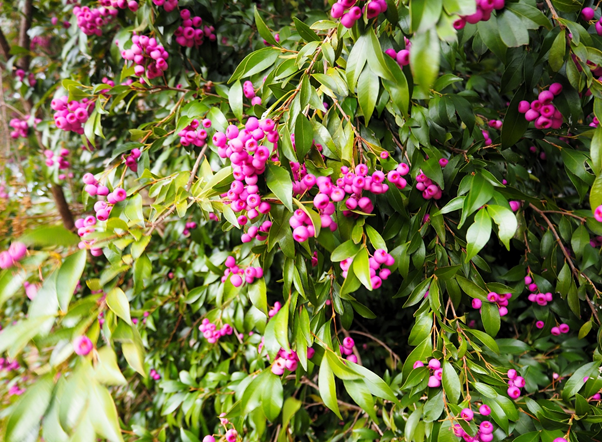 Syzygium smithii (Poir.) Nied. (Myrtaceae), located at the Australian National Botanic Gardens, Canberra (image credit: M. Turnbull). This taxon belongs to a native genus of trees/shrubs known for its cultural use and significance to First Australians, particularly for its timber and edible fruits. Lynley Wallis’ (2000) reference collection found that this genus in northwestern Australia has limited silica content and produces a few redundant phytolith morphotypes related to mesophyll and tracheary features, which is consistent with global findings (i.e. Runge 1996; Runge and Runge 1997).
With support from Hope and Bowdery, another ANU-based doctoral thesis was produced by Lynley Anne Wallis (2000) that reconstructed past landscape dynamics for semi-arid and tropical northwestern Australia. During this thesis project, Wallis generated a modern reference collection (Wallis 2003a) and collected modern sediment analogues (Wallis 2013) to provide a comprehensive archaeological-based vegetation history for this region (Wallis 2001; 2002; 2003b). ANU subsequently hosted the first – and to date only –Australian phytolith workshop in 2001, conceived and led by Wallis with support from Macquarie University and the Australasian Quaternary Association (AQUA). Likewise, this resulted in the only monograph dedicated to Australian phytolith research, which continues to be widely cited today (Wallis & Hart 2003).
Another outcome of this workshop was the collaboration between Bowdery, Wallis, and two other leading Australian phytolith researchers, Diane M. Hart and Carol Lentfer, to develop universal phytolith keys that clarified and standardised phytolith naming protocols (Bowdery et al. 2001). This provided a basis for the later development of the International Code for Phytolith Nomenclature (ICPN) by the International Committee for Phytolith Taxonomy (ICPT 2005; 2019), of which Wallis was an original committee member (Hart 2001). Wallis continued supporting Australian phytolith research efforts with archaeological teaching positions held at other Australian institutions, including James Cook University (2001–2002), Flinders University (2005–2009), the University of Queensland (2009–2011), the University of Notre Dame (2016–2020), and Griffith University (2020–present). This has also been supported by ‘Wallis Heritage Consulting’.
The most recent ANU-affiliated phytolith publication used phytoliths and other proxies to detect low-intensity Musa management in the Torres Strait over 2,000 years ago (Williams et al. 2020). This research was undertaken in collaboration with archaeologists and phytolith analysts based at the University of Sydney and University of Queensland, including Associate Professor Alison Crowther. The ANU TropArch group often includes information regarding phytolith concentrations and/or the inclusion of phytoliths (presence/absence information) in interdisciplinary micromorphological thin-section studies of Indo-Pacific sites (i.e. Denham and Grono 2017). For example, phytolith presence/absence information were incorporated into geoarchaeological studies of Australian sites such as Riwi Cave (Whitau et al. 2018).
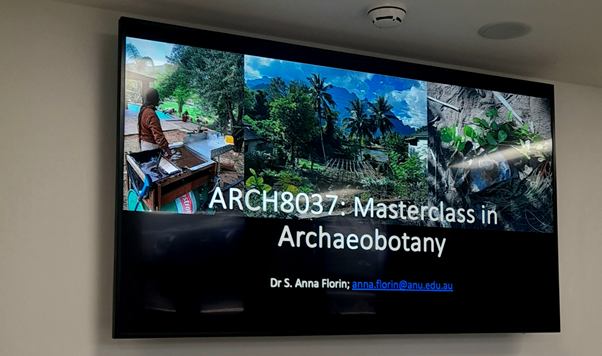 The ANU ‘Masterclass in Archaeobotany’ course held in November 2024 (image credit: M. Turnbull)
No ANU-based phytolith studies have been published since 2020; however, there have been recent efforts to revitalise phytolith research at ANU. Phytolith sciences were introduced to a one-week intensive graduate course, Masterclass in Archaeobotany, in November 2024, which was delivered by Turnbull as a guest lecturer. The course was developed and convened by Dr. S. Anna Florin, and examines people-plant relationships in the past, present and future. It is scheduled to run biennially as ARCH3043/6043 in the 2026 Spring Session.
 Turnbull teaching phytolith sciences during the ANU ‘Masterclass in Archaeobotany’ course held in November 2024 (image credit: S. Anna Florin)
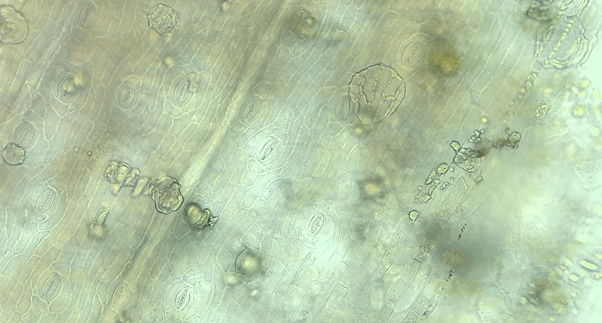
Phytolith spodogram from a modern Arecaceae leaf sample viewed under the microscope by students during the ANU ‘Masterclass in Archaeobotany’ course held in November 2024. Note: the formation of ELONGATE ENTIRE, STOMATA and SPHEROID ORNATE/ECHINATE phytolith morphotypes in articulation with cellulose material. Not to scale (image credit: M. Turnbull)
Future blog posts will continue to tell the story of other Australian phytolith research groups and analysts who have frequently collaborated with the ANU group. For a comprehensive history of Australian phytolith research, please refer to the 2023 paper:
Turnbull, M., Parker, A.G. & Jankowski, N.R. The history of phytolith research in Australasian archaeology and palaeoecology. Veget Hist Archaeobot 32, 655–677 https://doi.org/10.1007/s00334-023-00922-4
References
Bowdery D (1984). Phytoliths: A multitude of shapes. Honours thesis, The Australian National University, Canberra.
Bowdery D (1996). Phytolith analysis applied to archaeological sites in the Australian arid zone. PhD thesis, The Australian National University, Canberra.
Bowdery D (1999). Phytoliths from tropical sediments: Reports from Southeast Asia and Papua New Guinea. Bulletin of the Indo Pacific Prehistory Association 18:159–168.
Bowdery D (2007). Phytolith analysis, sheep, diet and fecal material at Ambathala pastoral station (Queensland, Australia). In M Madella & D Zurro (Eds.), Plants, People and Places: Recent Studies in Phytolith Analysis (pp. 134–150). Oxbow Books, Oakville.
Bowdery D (2015). An enigma revisited: identification of palm phytoliths extracted from the 1983 Rapa Nui, Rano Kao2 core. Veget Hist Archaeobot 24:455–466. https://doi.org/10.1007/s00334-014-0503-x
Bowdery D, Hart DM, Lentfer C & Wallis LA (2001). A universal phytolith key. In JD Meunier & F Colin (Eds.), Phytoliths: Applications in Earth Sciences and Human History (pp. 267–278). AA Balkema, Lisse.
Denham T & Grono E (2017). Sediments or soils? Multi-scale geoarchaeological investigations of stratigraphy and early cultivation practices at Kuk Swamp, highlands of Papua New Guinea. J Archaeol Sci 77:160–171. https://doi.org/10.1016/j.jas.2016.07.007
Hart D (2001). The state of the art in phytolith and starch research in the Australian-Pacific-Asian regions (Australian National University August 1-3, 2001). Quaternary Australasia 19(2): 10-11.
Runge F & J Runge (1997). Opal Phytoliths in East African Plants and Soils. In A Pinilla, J Juan-Tresserras & MJ Machado (Eds.), The State of the Art of Phytoliths in Soils and Plants (pp. 71-82). Madrid: Consejo Superior de lnvestigaciones Cientificas
Runge F (1996). Opal Phytolithe in Pflanzen aus demhumiden und semi-ariden Osten Afrikas und ihre Bedeutung fur die Klima- und Vegetationsgeschichte. Bot. Jahrb. Syst. Pflanzengesch. P£anzengeogr 3:303-363.
Wallis LA & Hart DM (2003). The history of phytolith researchers in Australia. In DM Hart & LA Wallis (Eds.), Phytoliths and starch research in the Australian-Pacific-Asian regions: the state of the art (pp. 1–17). Terra Australis 19, Pandanus Books, Canberra.
Wallis LA (2000). Phytoliths, late Quaternary environment and archaeology in tropical semi-arid northwest Australia. PhD thesis, The Australian National University, Canberra.
Wallis LA (2001). Environmental history of northwest Australia based on phytolith analysis at Carpenter’s Gap 1. Quat Int 83–85:103–117.
Wallis LA (2002). AMS Dates and Phytolith Data from Mud Wasp and Bird Nests at Carpenter’s Gap 1, Northern Australia. Aust Archaeol 55:35–39.
Wallis LA (2003a). An overview of leaf phytolith production patterns in selected northwest Australian flora. Rev Palaeobot Palynol 125:201–248. https://doi.org/10.1016/S0034-6667(03)000034
Wallis LA (2003b). Phytoliths and other microfossils in tufa formations as a novel source of palaeoenvironmental data. In DM Hart & LA Wallis (Eds.), Phytoliths and starch research in the Australian Pacific-Asian regions: the state of the art (pp. 31–42). Terra Australis 19. Pandanus Books, Canberra.
Wallis LA (2013). A comparative study of phytolith assemblages in modern sediments from the Kimberley, Western Australia. Quaternary Australasia 30:6–20.
Whitau R, Vannieuwenhuyse D, Dotte-Sarout E et al. (2018). Home is where the hearth is: anthracological and microstratigraphic analyses of Pleistocene and Holocene combustion features, Riwi Cave (Kimberley, Western Australia). Archaeol Method Theory 25:739–776. https://doi.org/10.1007/s10816-017-9354-y
Williams RN, Wright D, Crowther A & Denham T (2020). Multidisciplinary evidence for early banana (Musa cvs) cultivation on Mabuyag Island, Torres Strait. Nat Ecol Evol 4:1342–1350. https://doi.org/10.1038/s41559-020-1278-3